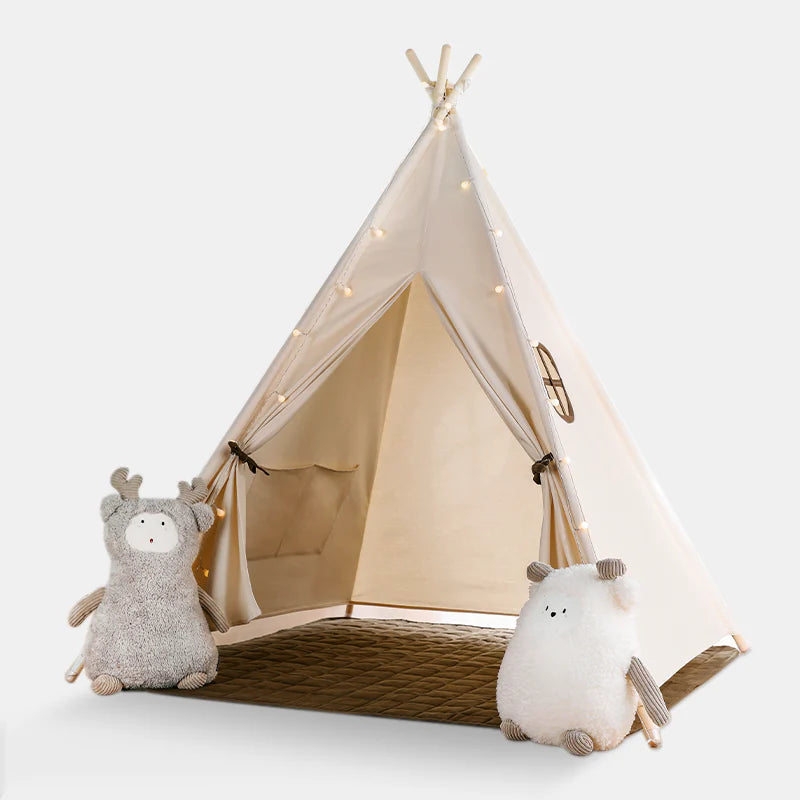

Besrey - Jan 28 2026
Pop-Up vs Pole Tents for Kids: Set-Up Speed, Stability, and Storage Compared

When deciding to buy a kids' play tent, we often overlook certain elements that might seem unimportant at first glance, but which you should definitely consider. One of the most common questions is: Should I buy a pop-up tent or a pole tent? Whichever you choose, consider the space it will occupy, its safety features, and its durability, whether for indoor or outdoor use.
This guide will allow you to compare pop-up and pole tents, considering the factors that matter most to us as parents: speed, safety, and everyday usability. Whether you're looking for the best play tent for your apartment or an option for your backyard, these considerations will help you make the best decision.
What “Pop-Up” and “Pole” Mean for Parents
First of all, we must define these two styles before making comparisons of their characteristics:
Pop-Up Tents
Pop-up tents are flexible structures that are easy to move once removed from their storage bag and ready to use without assembly. For parents, this means that:
· Extremely fast setup (seconds!), easy to pack away.
· It can be used on the beach for sun protection, in the backyard, or for camping on calm days.
· Children can participate in the assembly.
Pop-up tents are especially popular as kids play tents for indoor use.
Pole Tents
Pole tents feature a classic design with high peaks created by central poles and tensioned fabric. Although its installation requires a little more time, it allows you to:
· Strong, solid, and durable
· Simple assembly with color-coded poles or connectors, and folds compactly for storage in a carry bag
· Lightweight enough to move
· Designed to be a cozy nook for reading, pretend camping, fostering creativity
Parents often associate play tents with a more “traditional” camping experience, similar to real tents, only in a smaller size for children.
Set-Up Speed: Convenience vs. Structure
When it comes to speed, Pop-up tents have the advantage.
•Pop-up tents They can be assembled quickly and for indoor activities, or if you really don't want to deal with assembly time.
•Pole tents require several minutes of setup and adult involvement.
For busy parents with impatient children, pop-up tents offer instant fun. Pole tents can be especially useful when setup is part of the activity, such as teaching children basic camping skills.

Stability & Durability: What to Expect
Let's begin this comparison with two critical characteristics: stability and durability.
Pop-Up Tent
Stability: Stability is very low, thin frames made of fiberglass or steel, prone to bending or breaking in strong winds.
Durability: Shorter lifespan due to thinner materials and high pole tension; best for recreational use in good weather.
For indoor use, however, pop-up tents are usually stable and more suitable for quiet and supervised environments.
Pole Tent
Stability: High; excellent strength, weather resilience, suitable for large events or rough conditions.
Durability: Longer, Made of durable materials that withstand harsh conditions.
If you plan to use the tent outdoors, pole tents often feel more secure and long-lasting.
Safety & Standards: Fabrics and Flammability
Safety is another critical feature that concerns parents when choosing a kid's play tent.
Pop-Up Tents
Fabric: Often made of polyester or nylon, most offer water resistance but are usually thin fabrics.
Flammability: Quality matters a lot, since cheap models often burn quickly due to the fabrics.
Safety Focus: It focuses primarily on quick installation. Less focus on high-level fire safety unless specified.
Pole Tents
Fabric: Heavier and more durable materials, such as vinyl-coated polyester, often treated to resist fire.
Flammability: Typically meet stringent standards like CPAI-84 (Industrial Fabrics Association International) or NFPA requirements, meaning they resist ignition and self-extinguish.
Safety Focus: Stability and safety, requiring certified fire-resistant materials.
Pop-ups carry a higher inherent risk of flammability without certification; pole tents are generally safer due to mandated treatments. Always look for CPAI-84 or NFPA certification for any tent used, especially for pop-ups.

Apartment vs. Backyard Use
One of the determining factors is where the tent will be used regularly.
Pop-Up Tents
•Apartment/Small Space: Due to its compact and lightweight storage and super-fast installation, it is ideal for small internal patios, balconies and your favorite corner of the living room.
•Backyard Use: If you're planning a BBQ or a small party in your backyard, pop-up tent's easy to set up and move.
Pole Tents
•Apartment/Small Space: They are generally too large, bulky, and complex for typical apartment balconies; unsuitable for narrow corners or small rooms.
•Backyard Use: More robust than pop-ups, often better ventilation (removable rainfly), can be cost-effective for size.
Remember:
For quick, occasional shade on a balcony or small apartment: Choose a Pop-Up for speed and ease.
For backyard parties needing clear space and some stability: a Pole Tent works properly.
Apartment vs. Backyard Use
Decision Matrix: Pop-Up vs. Pole Tent
Feature | Pop-Up Tent | Pole Tent |
|---|---|---|
Setup | Extremely fast | Slower, requires assembling poles |
Durability | Lower; lighter materials, less wind-resistant. | Higher; thicker poles, sturdier fabrics, longer life. |
Portability | Lightweight, compact when packed (though circular). | Heavier |
Weather | Best for fair weather, light rain; can struggle in the wind. | Better in harsh weather, high resistance |
Space/Height | Often lower peak height, less interior room. | More spacious, higher ceilings available. |
Cost | Generally cheaper. | Generally cheaper. Can be more expensive, but offers better value long-term. |
Best For | Small apartaments | Backyards, family camping, bad weather, long setups. |
Quick Parent Checklist
Choose Pop-Up If:
· Need to set up fast
· Lightweight needed: Backpacking or easy transport.
· Not expecting harsh wind/rain.
· Looking for an affordable option.
Choose Pole Tent If:
· It offers stability if you choose a humid or windy climate
· More space/height: Ideal for backyards activities.
· Willing to spend more time setting up for a stronger tent.
Conclusion
For apartments, pop-up tents offer quick setup and portability for casual use, ideal for small apartments where setup ease matters most, while pole tents provide superior stability, durability, and unobstructed space for larger backyard gatherings or more serious weather, though they're bulkier and take longer to pitch. The choice depends on your priority: convenience & portability (Pop-Up) vs. strength & space (Tent Pole), with pop-ups great for quick shade and poles better for backyard activities or a home camping trip.
Whatever your choice, a well-made kids play tent can become the perfect space to encourage imagination, comfort, and creative play that motivates children to have a fun time instead of being in front of a screen.
Article credit:
https://campingguidance.com/what-is-a-pop-up-tent-how-do-they-work/#:~:text=Tents%20have%20Poles?-,Pre%2DAttached%20Pole%20Clips,the%20inside%20of%20the%20tent.
https://www.stuartrental.com/tent-rentals/pole-tents/#:~:text=What%20is%20a%20Pole%20Tent,never%20goes%20out%20of%20style.
https://www.amazon.com/besrey-Teepee-Infants-Kids-Toddlers/dp/B07PHKNL74?th=1
https://www.rocketcanopy.com/blogs/news/how-long-pop-up-tents-last-outdoors
https://www.mitkoforevents.com/blog/durable-pop-up-tent-8-elements-worth-checking-before-you-buy/#:~:text=With%20them%2C%20the%20tent%20stays,frame%20movement%20and%20faster%20wear.
https://gaxtent.com/es/blog/faq/pole-tent-vs-pop-up-tent/#